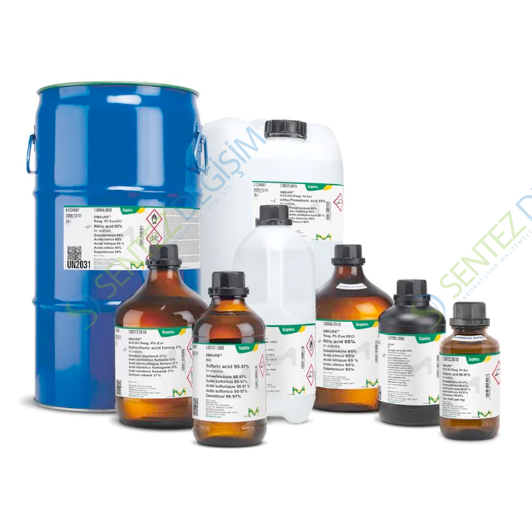
MERCK 110784.0100 Acrylamide For Electrophoresis CAS No.616-003-00-0
| Description |
|---|
| Catalogue Number | 110784 |
| Synonyms | Prop-2-enamide |
| Product Information |
|---|
| CAS number | 79-06-1 |
| EC index number | 616-003-00-0 |
| EC number | 201-173-7 |
| Hill Formula | C₃H₅NO |
| Chemical formula | CH₂CHCONH₂ |
| Molar Mass | 71.08 g/mol |
| HS Code | 2924 19 31 |
| Structure formula Image |
| Quality Level | MQ200 |
| Applications |
|---|
| Application | Acrylamide for electrophoresis. CAS No. 79-06-1, EC Number 201-173-7. |
| Physicochemical Information |
|---|
| Boiling point | 125 °C (33.3 hPa) |
| Density | 1.12 g/cm3 (30 °C) |
| Flash point | 138 °C not applicable |
| Ignition temperature | 424 °C |
| Melting Point | 84 °C |
| pH value | 5.2 - 6 (500 g/l, H₂O) |
| Vapor pressure | 2.1 hPa (84.50 °C) |
| Bulk density | 500 kg/m3 |
| Solubility | 2040 g/l |
| Toxicological Information |
|---|
| LD 50 oral | LD50 Rat 177 mg/kg |
| LD 50 dermal | LD50 Rabbit 1141 mg/kg |
| Safety Information according to GHS |
|---|
| Hazard Statement(s) | H301: Toxic if swallowed.H312 + H332: Harmful in contact with skin or if inhaled.H315: Causes skin irritation.H317: May cause an allergic skin reaction.H319: Causes serious eye irritation.H340: May cause genetic defects.H350: May cause cancer.H361f: Suspected of damaging fertility.H372: Causes damage to organs through prolonged or repeated exposure if swallowed. |
| Precautionary Statement(s) | P202: Do not handle until all safety precautions have been read and understood.P280: Wear protective gloves/ protective clothing/ eye protection/ face protection/ hearing protection.P301 + P310: IF SWALLOWED: Immediately call a POISON CENTER/doctor.P302 + P352 + P312: IF ON SKIN: Wash with plenty of water. Call a POISON CENTER/doctor if you feel unwell.P304 + P340 + P312: IF INHALED: Remove person to fresh air and keep comfortable for breathing. Call a POISON CENTER/doctor if you feel unwell.P305 + P351 + P338: IF IN EYES: Rinse cautiously with water for several minutes. Remove contact lenses, if present and easy to do. Continue rinsing. |
| Signal Word | Danger |
| RTECS | AS3325000 |
| Storage class | 6.1C Combustible, acute toxic Cat.3 / toxic compounds or compounds which causing chronic effects |
| WGK | WGK 3 highly hazardous to water |
| Disposal | 9Carcinogenic compounds and flammable compounds labelled "Highly toxic" or "Toxic": container F. Alkyl sulfates are carcinogenic; Take particular care to avoid inhalation and skin contact. To neutralize alkyl sulfates, add dropwise (from a dropping funnel) to concentrated ice-cool Ammonia solution (Cat.No. 105426) with vigorous stirring. Before placing in container D, check the pH with pH Universal indicator strips (Cat.No. 109535). |
| Safety Information |
|---|
| Categories of danger | carcinogenic, mutagenic, toxic, irritant, sensitizing, toxic for reproduction |
| Storage and Shipping Information |
|---|
| Storage | Store below +30°C. |
| Transport Information |
|---|
| Declaration (railroad and road) ADR, RID | UN 2074, 6.1, III |
| Declaration (transport by air) IATA-DGR | UN 2074, 6.1, III |
| Declaration (transport by sea) IMDG-Code | UN 2074, 6.1, III |
| Specifications |
|---|
| Appearance (color) | almost white |
| Appearance (description) | crystalline powder |
| Assay (GC) | ≥ 99.9 % |
| Identity (IR-spectrum) | passes test |
| Free acid (as acrylic acid) | ≤ 0.001 % |
| Absorbance A (290 nm; 1 %; 1 cm; water) | ≤ 0.15 |
| Conductivity (50 % w/v; water; 20° C) | ≤ 5.0 µS/cm |
| Solubility (50 % w/v; water) | clear, colourless |
| Turbidity (50 % w/v; water) | ≤ 2.0 NTU |
| Turbidity (50 % w/v; methanol; 37° C) | ≤ 3.0 NTU |
| pH-value (5 %; water) | 5.0 - 7.0 |
| Water-insoluble matter | ≤ 0.005 % |
| Global Trade Item Number |
|---|
| Catalogue Number | GTIN |
|---|
| 1107840100 | 04022536127651 |
| 1107841000 | 04022536127675 |