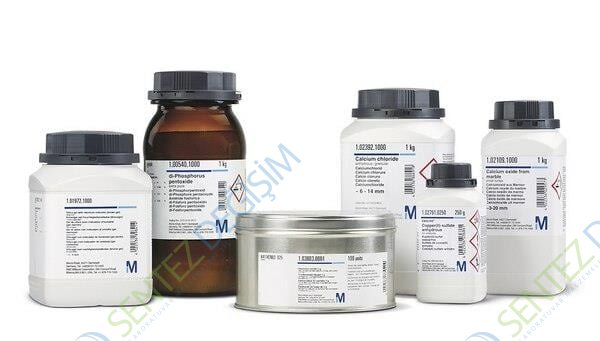
MERCK 107593.0100 Resorcinol GR CAS No.108-46-3
| Description |
|---|
| Catalogue Number | 107593 |
| Synonyms | 1,3-Dihydroxybenzene |
| Description | Resorcinol |
| Product Information |
|---|
| CAS number | 108-46-3 |
| EC index number | 604-010-00-1 |
| EC number | 203-585-2 |
| Hill Formula | C₆H₆O₂ |
| Chemical formula | C₆H₄(OH)₂ |
| Molar Mass | 110.11 g/mol |
| HS Code | 2907 21 00 |
| Structure formula Image |
| Quality Level | MQ100 |
| Physicochemical Information |
|---|
| Boiling point | 281 °C (1013 hPa) |
| Density | 1.28 g/cm3 (20 °C) |
| Explosion limit | 1.4 %(V) |
| Flash point | 127 °C |
| Ignition temperature | 605 °C |
| Melting Point | 110 - 113 °C |
| pH value | 4.4 (50 g/l, H₂O, 20 °C) |
| Vapor pressure | 0.1 hPa (20 °C) |
| Bulk density | 600 - 700 kg/m3 |
| Solubility | 1000 g/l |
| Toxicological Information |
|---|
| LD 50 oral | LD50 Rat 301 mg/kg |
| LD 50 dermal | LD50 Rabbit 3360 mg/kg |
| Safety Information according to GHS |
|---|
| Hazard Pictogram(s) | |
| Hazard Statement(s) | H302: Harmful if swallowed.H315: Causes skin irritation.H317: May cause an allergic skin reaction.H318: Causes serious eye damage.H370: Causes damage to organs if swallowed.H371: May cause damage to organs if swallowed.H410: Very toxic to aquatic life with long lasting effects. |
| Precautionary Statement(s) | P273: Avoid release to the environment.P280: Wear protective gloves/ eye protection/ face protection.P301 + P312: IF SWALLOWED: Call a POISON CENTER/doctor if you feel unwell.P302 + P352: IF ON SKIN: Wash with plenty of water.P305 + P351 + P338: IF IN EYES: Rinse cautiously with water for several minutes. Remove contact lenses, if present and easy to do. Continue rinsing.P308 + P311: IF exposed or concerned: Call a POISON CENTER/doctor. |
| Signal Word | Danger |
| RTECS | VG9625000 |
| Storage class | 6.1C Combustible, acute toxic Cat.3 / toxic compounds or compounds which causing chronic effects |
| WGK | WGK 2 obviously hazardous to water |
| Disposal | 3Relatively unreactive organic reagents should be collected in container A. If halogenated, they should be collected in container B. For solid residues use container C. |
| Safety Information |
|---|
| Categories of danger | harmful, irritant, dangerous for the environment |
| Storage and Shipping Information |
|---|
| Storage | Store at +15°C to +25°C. |
| Transport Information |
|---|
| Declaration (railroad and road) ADR, RID | UN 2876, 6.1, III |
| Declaration (transport by air) IATA-DGR | UN 2876, 6.1, III |
| Declaration (transport by sea) IMDG-Code | UN 2876, 6.1, III |
| Specifications |
|---|
| Assay (bromatometric, calculated on dried substance) | ≥ 99.0 % |
| Identity (IR-spectrum) | passes test |
| Melting range (lower value) | ≥ 109.0 °C |
| Melting range (upper value) | ≤ 111.0 °C |
| Chloride (Cl) | ≤ 0.001 % |
| Sulfate (SO₄) | ≤ 0.005 % |
| Heavy metals (as Pb) | ≤ 0.0005 % |
| Catechol | passes test |
| Phenol | ≤ 0.01 % |
| Sulfated ash | ≤ 0.02 % |
| Loss on drying | ≤ 1.0 % |
| Elemental impurity specifications have been set considering ICH Q3D (Guideline for Elemental Impurities). Class 1-3 elements are not likely to be present above the ICH Q3D option 1 limit, unless specified and indicated (*). |
| Global Trade Item Number |
|---|
| Catalogue Number | GTIN |
|---|
| 1075930100 | 04022536092843 |
| 1075930250 | 04022536092850 |