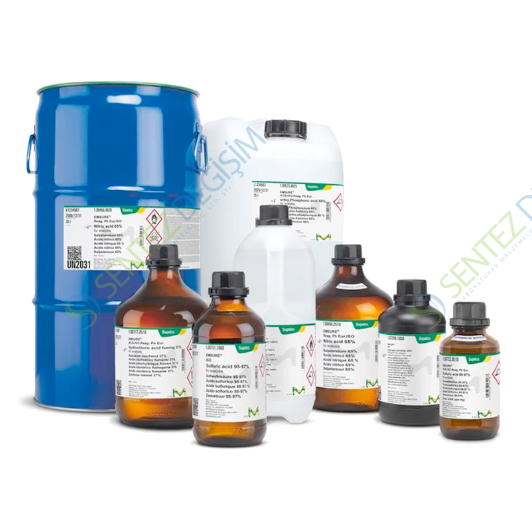
MERCK 104967.0100 Potassium Cyanide Gr For Analysis Acs,Iso,Reag. Ph Eur UN1680 6.1, I (izin/çevre) CAS No.151-50-8
| Description |
|---|
| Catalogue Number | 104967 |
| Replaces | PX1435; PX1435-5; PX1435-1; PX1435-20 |
| Synonyms | Cyanogen potassium |
| Product Information |
|---|
| CAS number | 151-50-8 |
| EC index number | 006-007-00-5 |
| EC number | 205-792-3 |
| Grade | ACS,ISO,Reag. Ph Eur |
| Hill Formula | CKN |
| Chemical formula | KCN |
| Molar Mass | 65.12 g/mol |
| HS Code | 2837 19 11 |
| Structure formula Image |
| Quality Level | MQ300 |
| Physicochemical Information |
|---|
| Boiling point | 1625 °C (1013 hPa) |
| Density | 1.55 g/cm3 (20 °C) |
| Melting Point | 634 °C |
| pH value | 11 - 12 (20 g/l, H₂O, 20 °C) |
| Bulk density | 750 kg/m3 |
| Solubility | 716 g/l |
| Toxicological Information |
|---|
| LD 50 oral | LD50 Rat 7.49 mg/kg |
| LD 50 dermal | LD50 Rabbit 14.29 mg/kg |
| Safety Information according to GHS |
|---|
| Hazard Statement(s) | H290: May be corrosive to metals.H300 + H310 + H330: Fatal if swallowed, in contact with skin or if inhaled.H372: Causes damage to organs through prolonged or repeated exposure.H410: Very toxic to aquatic life with long lasting effects.EUH032: Contact with acids liberates very toxic gas. |
| Precautionary Statement(s) | P262: Do not get in eyes, on skin, or on clothing.P273: Avoid release to the environment.P280: Wear protective gloves/ protective clothing.P302 + P352 + P310: IF ON SKIN: Wash with plenty of water. Immediately call a POISON CENTER/doctor.P304 + P340 + P310: IF INHALED: Remove person to fresh air and keep comfortable for breathing. Immediately call a POISON CENTER/doctor.P314: Get medical advice/ attention if you feel unwell. |
| Signal Word | Danger |
| RTECS | TS8750000 |
| Storage class | 6.1A Combustible, acute toxic Cat. 1 and 2 / very toxic hazardous materials |
| WGK | WGK 3 highly hazardous to water |
| Disposal | 6Sulfides and sulfites as well as other reducing substances, inorganic cyanides and isonitriles: Stir into sodium hypochlorite solution (Cat. No. 105614) and, if necessary, leave to react for several days. Caution: some substances may show a violent reaction! Draw off any toxic or flammable gases that may be formed. Excess oxidant should be neutralized with sodium thiosulfate (Cat. No. 106513). Container D or E. |
| Safety Information |
|---|
| Categories of danger | very toxic, dangerous for the environment |
| Storage and Shipping Information |
|---|
| Storage | NoTempLimit |
| Transport Information |
|---|
| Declaration (railroad and road) ADR, RID | UN 1680, 6.1, I |
| Declaration (transport by air) IATA-DGR | UN 1680, 6.1, I |
| Declaration (transport by sea) IMDG-Code | UN 1680, 6.1, I, Marine Pollutant: P, Segregation Group: 6 (Cyanides) |
| Specifications |
|---|
| Assay (argentometric) | ≥ 97.0 % |
| Chloride (Cl) | ≤ 0.02 % |
| Phosphate (PO₄) | ≤ 0.005 % |
| Sulfate (SO₄) | ≤ 0.01 % |
| Sulphide (S) | ≤ 0.0005 % |
| Thiocyanate (SCN) | ≤ 0.01 % |
| Fe (Iron) | ≤ 0.01 % |
| Na (Sodium) | ≤ 0.5 % |
| Pb (Lead) | ≤ 0.0002 % |
| Corresponds to ACS,Reag. Ph Eur |
| Global Trade Item Number |
|---|
| Catalogue Number | GTIN |
|---|
| 1049670100 | 04022536058375 |
| 1049670250 | 04022536058382 |
| 1049671000 | 04022536058399 |