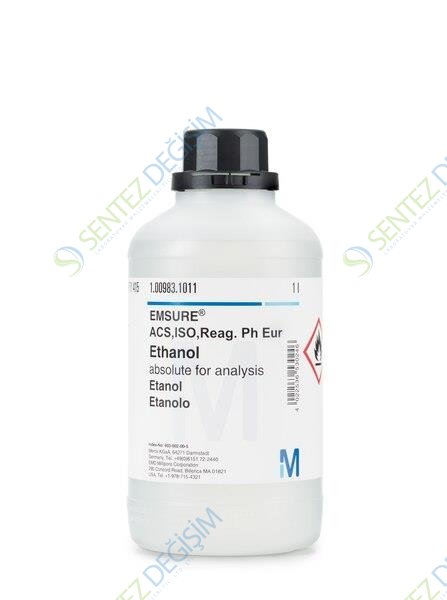
MERCK 100845.2500 Ethanolamine GR for Analysis CAS No.141-43-5
| Description |
|---|
| Catalogue Number | 100845 |
| Synonyms | 2-Aminoethanol, Monoethanolamine |
| Overview | EMSURE® grade solvents are suitable for a broad spectrum of classical lab applications, and are frequently used in regulated and highly demanding lab applications. EMSURE® provides worldwide best and most extensive product specifications. We declare our EMSURE® range to be in compliance with the ACS, with the reagent part of the European Pharmacopoeia (Reag. Ph Eur) and also with the ISO standards. |
| Product Information |
|---|
| CAS number | 141-43-5 |
| EC index number | 603-030-00-8 |
| EC number | 205-483-3 |
| Hill Formula | C₂H₇NO |
| Chemical formula | NH₂CH₂CH₂OH |
| Molar Mass | 61.08 g/mol |
| HS Code | 2922 11 00 |
| Structure formula Image |
| Quality Level | MQ300 |
| Physicochemical Information |
|---|
| Boiling point | 171 °C (1013 hPa) |
| Density | 1.015 g/cm3 (20 °C) |
| Explosion limit | 3.4 - 27 %(V) |
| Flash point | 91 °C |
| Ignition temperature | 410 °C |
| Melting Point | 4 °C |
| pH value | 12.1 (100 g/l, H₂O, 20 °C) |
| Vapor pressure | 0.5 hPa (20 °C) |
| Viscosity kinematic | 20 mm2/s (23 °C) |
| Toxicological Information |
|---|
| LD 50 oral | LD50 Rat 1515 mg/kg |
| LD 50 dermal | LD50 Rabbit 1025 mg/kg |
| Safety Information according to GHS |
|---|
| Hazard Pictogram(s) | |
| Hazard Statement(s) | H302 + H312 + H332: Harmful if swallowed, in contact with skin or if inhaled.H314: Causes severe skin burns and eye damage.H335: May cause respiratory irritation.H412: Harmful to aquatic life with long lasting effects. |
| Precautionary Statement(s) | P273: Avoid release to the environment.P280: Wear protective gloves/ protective clothing/ eye protection/ face protection/ hearing protection.P301 + P312: IF SWALLOWED: Call a POISON CENTER/doctor if you feel unwell.P303 + P361 + P353: IF ON SKIN (or hair): Take off immediately all contaminated clothing. Rinse skin with water.P304 + P340 + P310: IF INHALED: Remove person to fresh air and keep comfortable for breathing. Immediately call a POISON CENTER/doctor.P305 + P351 + P338: IF IN EYES: Rinse cautiously with water for several minutes. Remove contact lenses, if present and easy to do. Continue rinsing. |
| Signal Word | Danger |
| RTECS | KJ5775000 |
| Storage class | 8A Combustible, corrosive hazardous materials |
| WGK | WGK 2 obviously hazardous to water |
| Disposal | 3Relatively unreactive organic reagents should be collected in container A. If halogenated, they should be collected in container B. For solid residues use container C. |
| Safety Information |
|---|
| Categories of danger | harmful, corrosive |
| Storage and Shipping Information |
|---|
| Storage | Store at +2°C to +30°C. |
| Transport Information |
|---|
| Declaration (railroad and road) ADR, RID | UN 2491, 8, III |
| Declaration (transport by air) IATA-DGR | UN 2491, 8, III |
| Declaration (transport by sea) IMDG-Code | UN 2491, 8, III, Segregation Group: 18 (Alkalis) |
| Specifications |
|---|
| Assay (GC) | ≥ 99.5 % |
| Identity (IR-spectrum) | conforms |
| Al (Aluminium) | ≤ 500 ppb |
| B (Boron) | ≤ 20 ppb |
| Ba (Barium) | ≤ 100 ppb |
| Ca (Calcium) | ≤ 500 ppb |
| Cd (Cadmium) | ≤ 50 ppb |
| Co (Cobalt) | ≤ 20 ppb |
| Cr (Chromium) | ≤ 20 ppb |
| Cu (Copper) | ≤ 20 ppb |
| Fe (Iron) | ≤ 100 ppb |
| Mg (Magnesium) | ≤ 100 ppb |
| Mn (Manganese) | ≤ 20 ppb |
| Ni (Nickel) | ≤ 20 ppb |
| Pb (Lead) | ≤ 100 ppb |
| Sn (Tin) | ≤ 100 ppb |
| Zn (Zinc) | ≤ 100 ppb |
| Diethanolamine (GC) | ≤ 0.1 % |
| Triethanolamine (GC) | ≤ 0.1 % |
| Water (according to Karl Fischer) | ≤ 0.2 % |